
 Worldwide Shipping
 Trade Prices
 Next Day UK Delivery
 Excellent Customer Rating
Case Studies
Explore real-world examples of Rhino Shrink Wrap® in action.
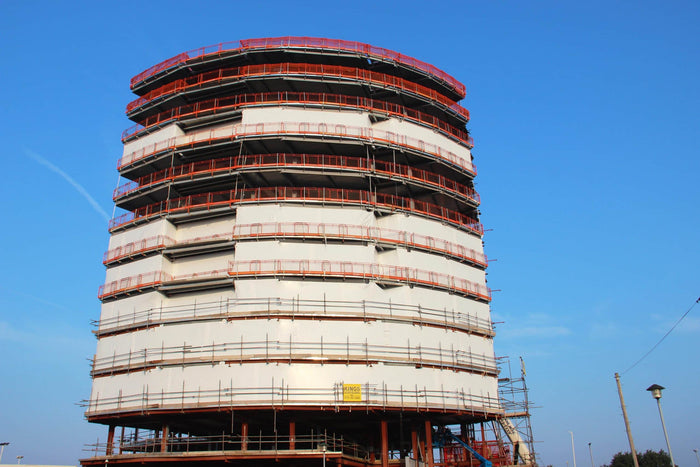
Herculaneum Quay
The Brief Herculaneum Quay is a development of 101 luxury apartments, situated on the bank of the River Mersey. This 15 storey residential tower by Primesites Developments is a significant size construction project for Liverpool. Because the construction site is located right on the banks of the Mersey, it is very exposed to everything the weather can throw at it. As the concrete is poured and floors are added, it will take some time before the permanent rain screen / glazing is installed. The main contractor, COREM, was looking for a temporary solution which would quickly make the building water-tight and enable them to proceed with the internal works in a dry & controlled environment. Temporary High Rise Weather Protection The solution was to use a shrink wrap screen, applied directly to the steel and concrete frame which would wrap the building and provide protection through the winter months. With a ceiling height of around 3m and with the supporting pillars set back from the edge of the concrete slab, Rhino Shrink Wrap were able to make a continuous 150m / 500′ run of shrink wrap around the perimeter of the building on a floor by floor basis. Rhino Shrink Wrap building screens are made from the same materials as our ‘signature’ scaffold wrap. It is an LDPE film that is easily joined by heat welding and which shrinks very powerfully when it is heated – (this is the secret of it’s ‘drum tight’ finish.) As standard, our screens are white in colour and allow almost all daylight through to the interior of the building. Our building wrap has flame retardant additives so that is meets the EN13501 fire retardant specifications and it has Ultra Violet inhibitors so it won’t become brittle when used outside. It is able to be used at a wide range of temperatures – we have used it in projects from Australia to Russia without any problems. Building Screen Installation Process The installation of our shrink wrap building screens is quite straightforward, whether fixing to concrete or steel framed building, the process is the same. The first step is to fix a run of wooden batten to the concrete or steel frame in the position where the shrink wrap screens are required. For a continuous run around the building, (where uprights are set back from the edge of the slab), this batten will be required along the ceiling and floor. Where the building uprights are directly adjacent to the edge of the slab, the shrink wrap will be installed on a ‘bay by bay’ basis and so batten will be required on the uprights also. Once this ‘picture frame’ of wooden batten has been installed, the shrink wrap sheeting is cut to size and hung in position. A second run of wooden batten is used to firmly secure the shrink wrap into position and is screwed firmly into the first batten. If there are no uprights / pillars at corners then the Rhino Shrink Wrap installation team install and tension an industrial grade strapping at the corners around which the shrink film is wrapped. Where a join is required between two sheets, this is achieved by overlapping two sections and using a hot air tool to created a bonded joint between the two sections. The final stage of the process is to use propane gas powered hot air tool to shrink the screens drum tight. This is achieved by passing hot air briefly over the surface of the shrink wrap sheeting. Shrink Wrap & Resistance to Wind Loading One thing that contractors often ask when they start to look at building screens is what wind speeds will they withstand. Now, exact wind speeds will vary from project to project because it depends on the size of the bays and the types of fixings we are using but let me give you an idea. A Force 10 wind, which is a wind speed of 55-63mph or over 100kph will extern a force of 0.77kn/m2. Now a typical bay of a concrete or steel frame building is often in the region of 3.5m high x 6m long which means that in a force 10, there is 17.5kn of Force on that sheet. Well, that is well within the capabilities of our shrink wrap sheeting which has a tensile strength at yield of around 26Kn. This means that sheeting can experience Force 10 winds and bounce back to it’s original taught state. Summary The Rhino Shrink Wrap team installed temporary weather protection around one floor of this high rise concrete and steel frame building each week. For the construction contractor, the ability to start the internal works before the external cladding and glazing is finished has brought a number of benefits – the projects are easier to manage, schedule, and the risk of delays and penalties is reduced. Thank you for taking the time to read this case study. Please do contact us with your questions or comments. We look forward to hearing from you.
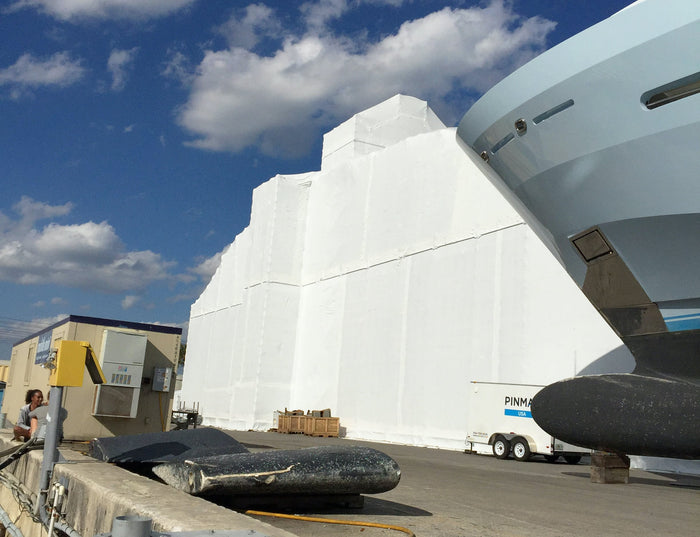
Superyacht Painting Tents
The Brief Shrink wrap sheeting is used in shipyards as a covering for ships and super yachts that are undergoing repair, refit and repainting. A shrink wrap tent allows work to take place in a controlled environment whilst containing dust and overspray from covering vessels located nearby. Paint Shed or Shrink Wrap Painting Tent? In an ideal world, the repainting and refinishing of all ships and superyachts would take place inside a dedicated paint shed. A dedicated building allows for optimum environmental and working conditions. However, it is often not be possible to find a paint shed that is available, or the vessel may may be too large. Even where a dedicated painting facility is available, costs can be high. Over the last decade, scaffolding tents have evolved to overcome some of these limitations with finding dedicated buildings. Once the scaffolding structure has been erected, industrial grade shrink wrap sheeting is used to create a continuously bonded skin around the yacht. The tents are fitted with heaters / air conditioning and powerful extraction systems in order to create the controlled environment required for painting. What are the benefits of shrink wrap yacht tent? Ashore or Afloat – A key benefit of using a shrink wrap tent for yacht painting is that it is possible for the yacht to remain in the water which can save on lifting and slipway / hard standing costs. Robust – A yacht tent may be exposed to high winds. However, because scaffold shrink wrap is shrunk ‘drum tight’ it will not flap or detatch in high winds. Effective containment - Welded joints between individual sheets of shrink wrap scaffold sheeting create highly effective environmental containment and temperature control within the tent. Versatility - Because it is a shrink to fit solution, which is cut and welded ‘in situ’ there is no restriction on the size and shape of the scaffolding structure. The shrink wrap tent may be designed to follow the shape of the yacht. It might look like just any plastic sheeting, but to create a scaffolding enclosure that will perform for the duration of a refit project requires a shrink wrap sheeting that is engineered with specific characteristics. Ask your supplier about; Thickness – Whilst a 200 micron (7 mil) thick film may be good enough for shrink wrapping small boats for transport and storage, for scaffold shrink wrapping you should consider using a shrink wrap film of at least 300 micron (12 mil) thickness. Why? These construction grade films will be stronger and have better resistance to ultra violet light. Flame Retardant - Most shipyards today insist that any temporary sheeting used is flame retardant. Always ensure that the material you are using is marked (printed) as flame retardant including the standard or specification to which it has been tested. Common flame retardant standards used around the world include EN13501 in Europe and NFPA in the USA Ultra Violet Inhibitor - When a shrink wrap sheeting is exposed to sunlight over a long period of time it will begin to break down and become brittle. You should be suspicious of suppliers who claim that a shrink wrap film will have a life span of many years because this suggests that the film is not flame retardant or has minimal flame retardant additives (flame retardant and ultra violet inhibitor additives always compete.) Shrink Ratio - It seems fairly obvious that shrink wrap sheeting should shrink but there can be huge variations in performance between brands. Ask your supplier for a specification sheet and check the shrink ratio. You need a shrink wrap film that has balanced shrinkage. It will not be precisely the same but a shrink ration of around 60/40 is optimum. This will ensure that the sheeting shrinks very tightly around the scaffolding structure. Choosing Your Scaffolding Company Erecting a scaffolding structure around a super yacht is a skilled profession. These are some of the key points to consider when looking for a superyacht scaffold tent. Safety Safety should always come first when erecting and using scaffolding. Whilst basic structures may not require special permits, those that are longer, taller may require that engineering drawings be produced. As a minimum, the scaffolder should complete a detailed risk assessment and method statement prior to work commencing. Training Any scaffolding company should have proper training. Those that are registered with scaffolding bodies in the UK must have this training. Always ensure that you are dealing with a company or individual that has been trained in the proper use of scaffolding. Insurance It is a legal requirement in most countries that any company with employees has employers’ liability insurance. As the person responsible for employing the scaffolding, it is your responsibility to ensure that the company in question has appropriate insurance, Public liability insurance is also a legal requirement, and this ensures that if any damage is done to property or people are injured as a result of the scaffolding company’s work, they are insured to cover the damage. Experience Whilst standard scaffolding construction may be within a companies capability, the completion of marine scaffolding around a ship or superyacht may be considerably more difficult. In these cases, experience counts, and it will be required. Ask for examples of similar jobs undertaken. At Rhino we have worked with many scaffolding companies world-wide who specialise in shipyard work. If you require any assistance call our friendly team today.